

Go back to RESOURCES
Published in JACC: Basic to Translational Science, Mohran et al. explore how aficamten inhibits force development, while also showing how aficamten and another negative inotrope, mavacamten, differ mechanistically. Aficamten treats obstructive hypertrophic cardiomyopathy by inhibiting cardiac myosin ATPase and lessening contractile force. The authors show that aficamten acts by slowing myosin ATPase cycling kinetics without changing its structural organization (a key difference between aficamten and mavacamten). Both compounds significantly inhibited peak tension in engineered heart tissue made from hiPSC-CMs. And, while both sped relaxation times, time to peak tension was slower for mavacamten and not aficamten.
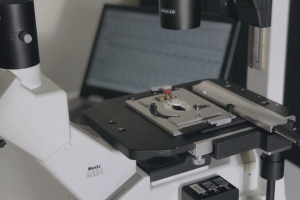
For the assays utilizing EHTs mentioned above, the authors used their IonOptix MyoClamp System (formally named Intact Muscle Chamber System). After releasing the system almost a decade ago, we followed up with a similar system focused on living myocardial slices (known as our Cardiac Slice System). Both systems use identical components including the same force transducer, manual tensioning, and programmable motor. In fact, only the chamber inserts differ with respect to the system’s recording hardware, and those inserts interchange easily. The preparation and mounting of tissues differ significantly, but the system’s chamber can easily accommodate a variety of tissue either mounted via platinum omega clips sutured to tissue ends and stimulated directly as performed in the aforementioned paper, or glued to clips and field stimulated as is done with thin myocardial slices. The system has been used to collect functional data from myocardium, papillary, EHTs as illustrated in this publication, as well as soleus, EDL, and even engineered skeletal muscle.
Mohran S, Kooiker KB, Naim A, Pilagov M, Asencio A, Turner KL, Ma W, Flint G, Jiang S, Zhao J, McMillen TS, Mandrycky C, Mahoney-Schaefer M, Irving TC, Tanner BCW, Kad NM, Regnier M, Moussavi-Harami F (2025). Myosin Modulator Aficamten Inhibits Force by Altering Myosin’s Biochemical Activity Without Changing Thick Filament Structure. JACC Basic Transl Sci. 2026 Jan;11(1):101449. doi: 10.1016/j.jacbts.2025.101449.