

Visit us at the 2026 Myofilament Meeting!
Location: Harvill Auditorium | Tuscon, Arizona, USA
Meeting Dates: 23 – 26 May, 2026
IonOptix is proud to sponsor the 2026 Myofilament Meeting, the preeminent gathering of scientists investigating pioneering research in myofilament biology and muscle function. We’re excited to exhibit at the meeting as well as to demonstrate our MyoClamp system at the Myofilament Workshops on Tuesday afternoon (see below for more info).
We’re looking forward to learning more about your objectives and how we can support your research! We will be represented by Drs. Michiel Helmes and Adam Veteto from our EU and US offices, respectively.
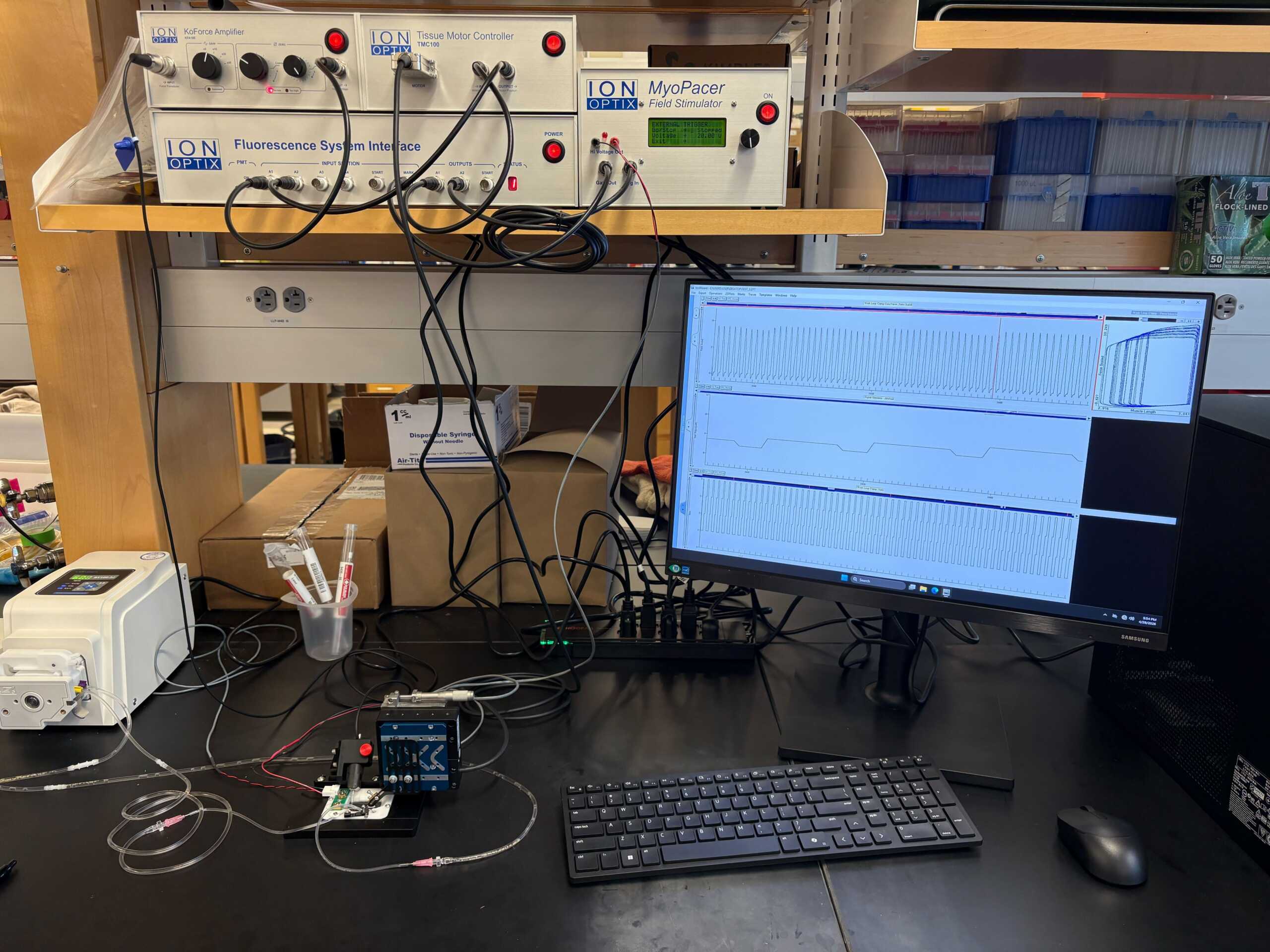
Visit us on Tuesday, May 26 in the University of Arizona’s state-of-the-art Medical Research Building, beginning at 2:30 pm. We will show how to prepare, mount, and tension thin myocardial slices, as well as how to record force development and clamp forces to generate force-length work loops.
The IonOptix MyoClamp System provides high-content, functional data from multiple different tissue types including living myocardial slices, papillary muscle, and engineered heart tissue as well as skeletal preparations like soleus and EDL muscle. Our KoForce force transducer permits sensitive, high-speed, high-resolution acquisition of force development from as little as 15 nN to over 100 mN. Equipped with our robust moving coil long travel actuator with 20 nm resolution, the MyoClamp System enables force-feedback length control in cardiac tissue to emulate pressure-volume loops (requires minimum forces of ~1 mN). These force-length and stress-strain work loops can be used to derive important parameters using IonWizard’s Power Analysis to describe important functional characteristics including end-systolic and end-diastolic force-length/stress-strain relationships characterizing the mechanical stiffness of the tissue as well as contractile performance.
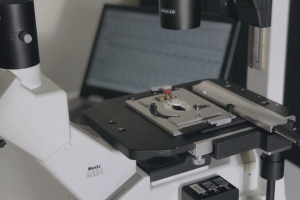
The platform can be used as a benchtop unit or, thanks to our chamber’s optically transparent bottom, mounted atop the stage of an inverted microscope for imaging. When combined with the IonOptix Calcium and Contractility System, fluorescence of quantitative, ratiometric dyes such as Fura-2 and/or CalRed can be detected using IonWizard, also permitting control of experiment acquisition parameters and comprehensive data analysis. Resting sarcomere length can also be detected in thin tissue preparations (a useful method to set cardiac tissue preload).